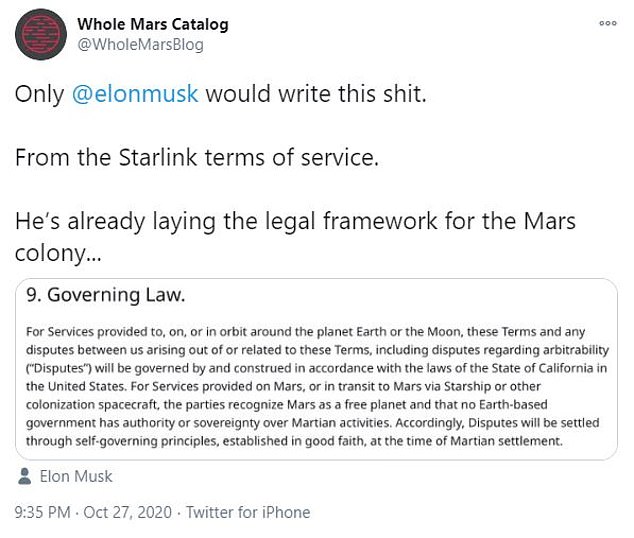
A viral TikTok highlighted a clause within Starlink’s terms of service that explicitly designates Mars as a “free planet.” The language is active and verifiable on SpaceX’s website, with the company’s own Securities and Exchange Commission filing confirming its intent.
The clause states: “For Services provided on Mars, or in transit to Mars via Starship or other spacecraft, the parties recognize Mars as a free planet and that no Earth-based government has authority or sovereignty over Martian activities. Accordingly, Disputes will be settled through self-governing principles, established in good faith, at the time of Martian settlement.”
Space lawyers have characterized this clause as legally insignificant, aligning with interpretations of the 1967 Outer Space Treaty. Article II of that treaty prohibits national claims on celestial bodies, while Article VI holds countries accountable for private companies’ activities in space. Consequently, U.S. authorities retain oversight responsibility for SpaceX’s operations on Mars.
SpaceX’s recent Securities and Exchange Commission filing reveals Elon Musk’s compensation hinges on achieving specific targets: a market valuation of up to $7.5 trillion and the establishment of a permanent human colony on Mars with at least one million inhabitants. The clause, critics note, functions less as legal regulation and more as an invitation to envision humanity’s next frontier—a world unclaimed by Earth-based governments.
SpaceX accounts for approximately 85–90 percent of all human space launches globally. China has made significant strides in the sector: landing on the Moon’s far side in 2019, returning lunar samples in 2024, and deploying a Mars rover in 2021—the second nation to achieve this milestone. Musk’s Starshield program, which includes spy satellites for the National Reconnaissance Office under a reported $1.8 billion contract, underscores the military dimension of these ambitions.
The article examines governance questions raised by Musk’s vision: he has proposed that Martian settlers establish direct democracies with concise laws. Historical precedents include Wernher von Braun, who later designed America’s Saturn V rocket, writing a novel in 1949 about early Mars expeditions—later published in English in 2006—and the hypothetical title “The Elon” for Martian leadership, reportedly originating from Musk’s father.
Initial settlers would likely be wealthy individuals or professionals whose costs are covered by others, shaping an astronaut-focused colony rather than a tourist destination. Musk has repeatedly missed deadlines for Starship missions to Mars, including failing to achieve an uncrewed mission this year. His current timeline suggests a Moon city within ten years and potential Martian settlement within five to seven years.
The Red Planet lacks Earth’s natural heritage—forests, oceans, cathedrals, common law, or hockey rinks. The first child born there would exist without direct ties to Earth’s legacy, raising profound questions about the future of human civilization.
EZRA LEVANT | SEPTEMBER 29, 2026 | NEWS ANALYSIS